
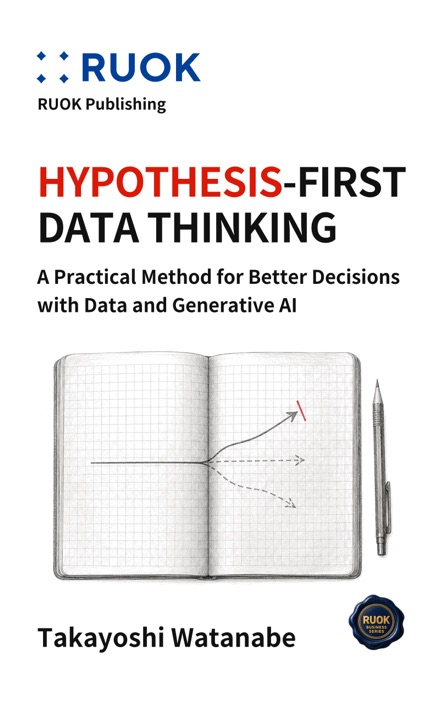
RUOK Business Series #1
Hypothesis-First Data Thinking
BI tools are in everyone’s hands. Your CRM turned the pipeline into numbers. And those numbers still don’t turn into value. This book is for you if that sounds familiar.
You got good at analysis. So why does every meeting still end with “let’s take this away and dig deeper”?
A Practical Method for Better Decisions with Data and Generative AI. 『データ仮説思考』の英語版です。

Available in Kindle and paperback
More data, better tools, and now generative AI — yet the decision still doesn’t arrive. The problem isn’t skill. It’s order.
This book flips the sequence: form the hypothesis first, then look only at the data you need to prove it right or wrong. That one flip turns analysis from busywork into judgment.
- Flip the order: hypothesis first, data second
- Rewrite every claim as a falsifiable sentence
- Verify only the links you can actually test
- The answer lives inside your own company
- Drop one number you look at every week
Recognize this meeting?
- The weekly sales meeting where everyone has seen the dashboard, and the meeting still ends with “let’s take this away and dig deeper.”
- Leadership said “be data-driven,” so every collectible number got collected — and now nobody can say which decision any of it was for.
- You handed sales data to a generative AI and asked it to “analyze this.” The summary came back polished. Tomorrow’s actions didn’t change at all.
The whole book, in one picture
Analysis for its own sake
The hypothesis decides the scope of analysis
Three things you can do today, without buying the book
- 1
Ch.1 — Ask once, this afternoon
“What is this analysis supposed to decide?” One ask per request, never repeated. The requests that can answer and the ones that cannot separate on the spot.
- 2
Ch.2 — Rewrite today’s problem in one sentence
Observable subject, measurable verb, one comparison point. Read it back tonight: “If this is wrong, which number tells me?”
- 3
Ch.3 — Drop one number
Write down every number you review weekly, ask of each “when it moves, who does what?” and drop one unanswerable number from this week’s meeting. If nobody notices, that silence is the answer.
Read the opening
Prologue: What Is This Analysis Supposed to Decide?
“Do we actually need this analysis?”
The moment those words land in a meeting room, the air stiffens. If you have felt that, you are not alone.
Here is the kind of situation I mean. A company spends three months on market research to decide whether to launch a new business. The data comes in. The deck gets thick. And by the time the conclusion is ready, a competitor has already shipped into that market. The analysis was careful. The decision was late.
Invented or not, most readers will recognize the pattern. The analysis takes so long that conditions have changed by the time a verdict arrives. Or a handsome report circulates and nowhere in it does anyone say what to do differently tomorrow morning. I hear this across every industry.
What I propose instead is an approach I call hypothesis-first data thinking. Its purpose is single. Take the experience and instinct you have built up in your work, combine them with a new tool — generative AI — and turn them into judgments that are both fast and hard to get wrong.
All company names, people and numbers in the book are invented. None of them are real.
More from the book (3 figures)
Seven Steps to a Hypothesis
- Step 1 Put the problem into words that leave no room for misreading
- Step 2 Draw the possibilities up from the floor
- Step 3 Use generative AI to fill in what you cannot see
- Step 4 Arrange the candidates as a structure
- Step 5 Set the order
- Step 6 Design the test
- Step 7 Run it, and fix it while running
A process planned for three weeks
Leading/lagging causal chain
You can only verify the links that are connected.
The Integrated Worksheet
- 1What are we deciding?
- 2By when do we decide?
- 3Current situation (as a situation, not a symptom)
- 4Hypothesis (observable subject, measurable verb)
- 5If this result comes back, we drop the hypothesis
- 6Data needed (nothing you will not look at)
- 7Who collects it, by when
- 8When the number moves, who does what
- 9Approvals, budget and people required
A row you cannot fill is today’s real problem
What is in the book
Chapter 1: The Core Ideas of Hypothesis-First Data Thinking
Flip the order — hypothesis first, data second; write the discard condition before looking; keep generative AI to blind-spot checks and drafts.
- Prologue: What Is This Analysis Supposed to Decide?
- 1. How Hypothesis-First Data Thinking Works
- 2. Why This Approach Became Necessary
- 3. The Practical Form: STAR for Data Hypotheses
- 4. How to Build In Generative AI
- 5. Making It Stick in the Organization
- Epilogue: The Map and the Walking
- Chapter Exercises / Summary
Chapter 2: The Craft of Building a Hypothesis
Rewrite unfalsifiable claims (“quality awareness is low”) into observable subjects and measurable verbs — seven steps, walked through a full worked example in manufacturing.
- The Symptom Called Analysis Fatigue
- 1. Two Ways Into the Same Problem
- 2. Write the Hypothesis as a Causal Chain
- 3. Seven Steps to a Hypothesis
- 4. The Structure One Week Revealed
- 5. Taking the Approach Beyond One Department
- 6. What This Example Left Behind
- Chapter 2, Down to the Bones
Chapter 3: Collecting Data, and Making It Efficient with AI
The answer only exists inside your own company: name the data each hypothesis needs, let generative AI lighten the collection work, test small, survive premise changes.
- Not Drowning in the Sea of Data
- 1. Start from the Purpose
- 2. The Answer Only Exists Inside Your Own Company
- 3. So What Do You Actually Collect?
- 4. Test It Small
- 5. When the Premise Changes
- 6. What Three Months Revealed
- 7. What to Do Tomorrow
- What This Chapter Settled
Appendix: The Integrated Worksheet, on One Page
Nine rows from “What are we deciding?” to approvals, budget and people — hypothesis to action on a single page. A row you cannot fill is today’s real problem.
What you’ll learn to do
- Write every claim as a falsifiable sentence
- So even a dead hypothesis becomes an asset.
- Stop “comprehensive” data collection without fear
- Look only at what can change the verdict.
- Connect leading and lagging indicators
- And test only the links you can actually observe.
- Put generative AI to work
- ChatGPT, Claude and Gemini for finding your blind spots and drafting your tests.
- Reach a three-value verdict
- Reject, provisionally supported, or inconclusive — instead of rubber-stamping.
Who this book is for
Written for managers, sales ops, and transformation leads — not data scientists.
- What you keep when you finish is one page: the Integrated Worksheet at the back. Hypothesis to action, all on it.
- Worked examples span e-commerce, manufacturing, retail and sales — one of them will be close to your own.
- A diagram every three pages, so you can work as you read (46 in total).
About the author
Takayoshi Watanabe has spent thirty years on the front lines of Japanese and global companies, leading sales transformation and hands-on data adoption: SFA/CRM rollouts, building data-driven sales organizations, corporate training and advisory.